







EXOTIC LEATHER BUYING GUIDE (NEW)
1. SPECIES SELECTION: CHOOSING THE RIGHT HIDE
Exotic leathers are categorized by species, each yielding distinct scale structures, tensile strength, and ideal applications.
| Species | Key Characteristics | Scale |
Best Applications |
| Porosus Crocodile (C. porosus) | Pinnacle of luxury; small, highly symmetrical square scales; distinct sensory pore on each scale. | Uniform, fine square scales transitioning seamlessly into small round flank scales. | High-end handbags, luxury watch straps, bespoke footwear. |
| Niloticus / Nile Crocodile | Larger scale profile than Porosus; regal appearance; soft, supple feel. | Slightly larger square belly scales; square-to-round transition. | Large tote bags, luggage, luxury outerwear, upholstery. |
| American Alligator (A. mississippiensis) | Smooth, clean belly tiles with zero umbilical pores; rich, deep dye absorption. | Clean square scales with smooth tile centers; iconic web-patterned flanks. | Bespoke boots, wallets, belts, structured bags. |
| Varanus / Ring Lizard | Ultra-durable, thin profile; non-stretching; beautiful tile symmetry. | Small, beaded tile pattern with natural ringed pigmentation or solid unbleached tones. | Small leather goods (SLGs), watch straps, shoe accents, bookbinding. |
| Reticulated Python | Extremely pliable; dramatic natural markings or clean bleached finishes. | Wide, smooth belly scales flanked by detailed back scale lattice. | Garments, boots, statement handbags, wide belts, panels. |

2. CUT VARIATIONS: BACK CUT VS. FRONT CUT
How the hide is opened along the belly or back completely changes the aesthetic and usable surface area.
       FRONT CUT (Belly Cut)                   BACK CUT (Spine Cut)
 [Opened down the Center Back]            [Opened down the Center Belly]
 ______________________________          ______________________________
|   /\    Belly Center    /\   |        |   /\     Spine / Horns   /\  |
|  /  \  (Smooth Tiles)  /  \  |        |  /  \   (3D Texture)    /  \ |
| /____\                /____\ |        | /____\                 /____\|
|______________________________|        |______________________________|
   Ideal for: Handbags, Wallets            Ideal for: Western Boots, Jackets,
   & Clean Luxury Goods                    Rustic / Textured Statement Pieces
-
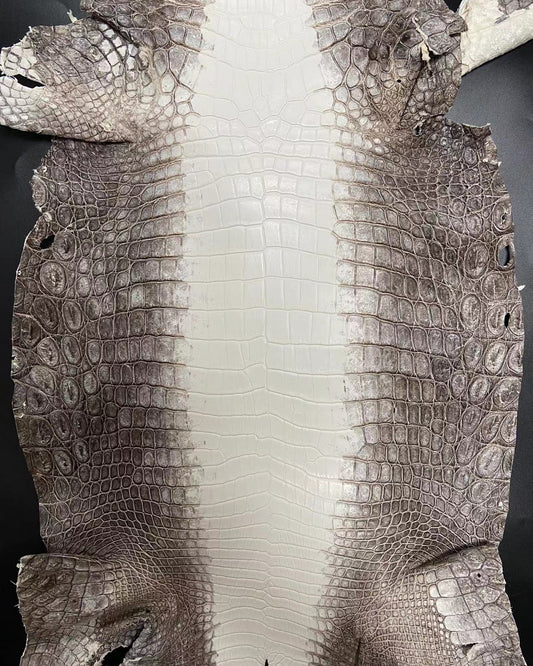
Front Cut (Belly Cut / Back Opened): The hide is sliced along the spine. This leaves the smooth, prized belly scales completely intact in the center. Used for 90%+ of luxury fashion, wallets, and handbags.
-
Back Cut (Spine Cut / Belly Opened): The hide is sliced down the belly. This keeps the textured spinal ridge, scales, or osteoderms (hornback) intact in the center. Ideal for Western boots, statement jackets, and high-texture accessories.

3. SIZING & MEASUREMENT METRICS
Exotic skins are measured differently than standard cowhide (which is measured in square feet).
A. Crocodile & Alligator Measurement (Centimeters across the Belly)
Crocodilian hides are priced and measured by width at the widest point of the belly (widest area between the two flanks).
-
30 cm – 34 cm: Ideal for watch straps, small wallets, key fobs, shoe accents.
-
35 cm – 39 cm: Perfect for bi-fold wallets, clutch bags, medium accessories.
-
40 cm – 49 cm: Standard size for structured handbags, tote panels, footwear.
-
50 cm+: Rare, premium hides required for large travel bags, weekenders, and seamless garment panels.
B. Lizard Measurement (Centimeters at the Widest Point)
-
Measured across the belly width (typically 25 cm to 38 cm+).
C. Python Measurement (Meters in Length & Width at Mid-Body)
-
Measured by width at the widest point (cm) and total length (meters) (e.g., 30cm+ width x 3.0m+ length).

4. GRADING STANDARDS & YIELD CALCULATION
Exotic hides are graded based on the presence of natural flaws, scars, bites, or tannery cuts within the primary usable zones.
+------------------------------------+
|  ZONE 1 (Head)     |  ZONE 2 (Tail)|
|--------------------+---------------|
|  ZONE 3 (Belly L)  |  ZONE 4 (R)   |  <-- The Prime Cutting Area
+------------------------------------+
Official Grade Definitions:
-
Grade 1 (Flawless / Museum Grade): Zero defects or scars in the prime belly square (Zones 3 & 4). 100% yield potential for high-visibility panels.
-
Grade 2 (Minor Natural Markings): 1 minor imperfection near the outer flanks or tail. Yields ~85–90% usable area for large goods, 100% for SLGs.
-
Grade 3 / Grade 4 (Craft / Utility Grade): Noticeable natural scars, pinholes, or tannery defects. Ideal for small goods (watch straps, cardholders) where flaws can be cut around.
5. FINISHES & ANILINE TYPES
-
High-Gloss Glazed: Finished using traditional agate stone pressure polishing. Creates a reflective, mirror-like surface that highlights scale elevation.
-
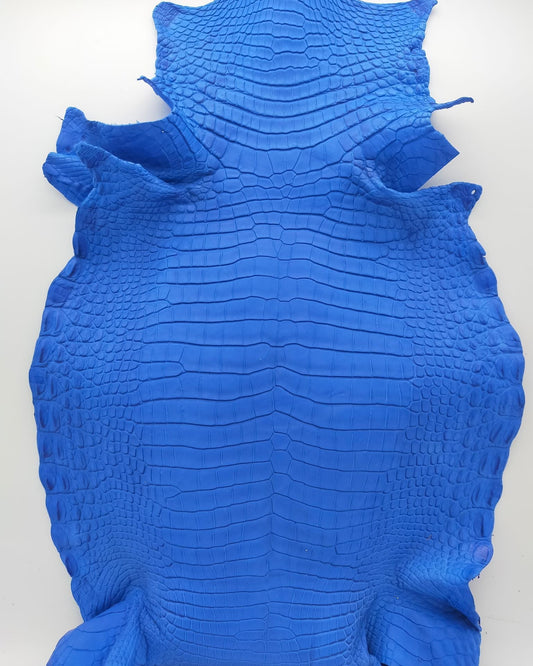
Matte / Lisse: Soft, natural finish with a subtle sheen. Pliable, modern, and highly resistant to surface creasing.
-
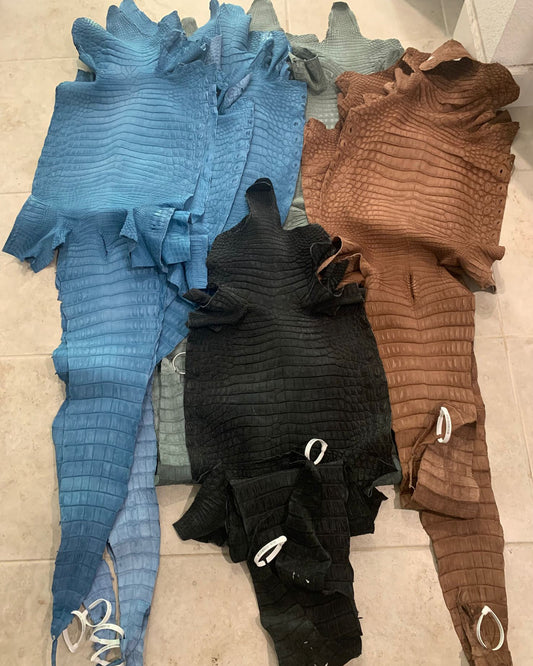
Nubuck / Suede Finish: Buffed scale surface creating a velvety touch while retaining scale structure.
-
Millennium / Metallic Wash: Hand-painted or foil-stamped accents on scale edges for dimensional luxury effects.
6. PRICING & YIELD FORMULA
When estimating costs for custom projects, use this simple formula:
-
Note: Exotic hides require a 15% to 25% waste allowance due to pattern matching and scale orientation across seams.
-
Aniline Dyed: Leather soaked in transparent dye that permeates the entire skin without a heavy surface coating, keeping all natural grain characteristics visible.
-
Back Cut (Spine Cut / Hornback): A hide opened along the belly, leaving the raised 3D spinal ridges or hornback scale texture intact down the center.
-
Belly Cut (Front Cut): A hide opened along the spine, keeping the smooth, highly prized belly scales intact across the central surface area.
-
Blemish: A natural defect or flaw in the hide that affects its color or finish.
-
Brand: A man-made mark burned or stamped onto the hide used to identify the animal.
-
Chrome Tannage: A tanning process using chromium salts and minerals to produce vibrant colors and supple flexibility.
-
CITES Certification: Official documentation under the Convention on International Trade in Endangered Species verifying legally sourced, ethically traded exotic skins.
-
Crown / Headplate: The distinct, raised cluster of rigid scales located directly behind the skull on crocodilian hides.
-
Crust: Tanned leather that has been dried but not yet dyed, oiled, or finished.
-
Defect: Any natural marking on the skin, such as scratches, bite marks, or healing scars.
-
Distressed Leather: Leather treated during finishing to create a worn, aged, or vintage appearance.
-
Drum Dyeing: Submerging and tumbling hides in a dye-filled drum to achieve deep, uniform color penetration through the skin.
-
Embossed Leather: Standard cowhide heat-stamped with metal plates to imitate exotic scale or animal grain patterns.
-
Fat Wrinkle: Natural creases or surface lines caused by fat deposits on the live animal.
-
Finish: The final surface coating, glaze, or texture applied to a leather hide.
-
Flank: The outer side regions of an exotic skin, featuring smaller, rounder scale patterns surrounding the central belly tiles.
-
Glazed Finish: A high-gloss, mirror-like finish created by polishing the hide under intense pressure using an agate stone cylinder.
-
Grade (Grades 1–4): The standardized quality rating of a hide based on clean, defect-free usable quadrants (Grade 1 represents a flawless primary cutting area).
-
Grain: The natural pore or scale structure that gives leather its distinct surface texture.
-
Hand: A professional term referring to the tactile softness, drape, and feel of a finished hide.
-
Hide: The raw or tanned skin or pelt of an animal.
-
Matte / Lisse Finish: A soft, natural low-sheen finish that maintains maximum suppleness and authentic scale feel.
-
Measurement (Belly Width): The standard industry metric for crocodilian hide pricing, measured in centimeters across the widest point of the belly.
-
Nubuck: Leather buffed on the grain side to create a soft, suede-like nap.
-
Osteoderm: Bony calcium deposits embedded inside the scale structure of certain crocodilians (e.g., Caiman), giving the hide a rigid feel.
-
Patent: A high-gloss surface achieved by applying a resin or lacquer coating over the skin.
-
Patina: Color variations, sheen, and character developed naturally on the leather surface through age and handling.
-
Perforated Leather: Leather punched with uniform patterned holes for breathability or aesthetic detail.
-
Pore / Sensory Pore: A distinct micro-dot pore found near the trailing edge of scales on true crocodile species (like Porosus and Niloticus), absent on Alligator.
-
Pull-Up: Leather treated with oils and waxes that temporarily lightens in shade when stretched or creased.
-
Quill (Ostrich): The raised, bumpy follicle pattern characteristic of ostrich body leather.
-
Skive: Slicing or shaving the flesh side of a hide to achieve a precise, uniform thickness for crafting.
-
Suede: Leather buffed on the flesh side to produce a velvety nap.
-
Tannage: The chemical process used to treat raw skins, converting them into durable leather resistant to decomposition.
-
Umbilical Scar: The natural elongated scar slit on the lower central belly of crocodilians, utilized by crafters as a symmetry alignment mark.
-
Vegetable Tannage: Tanning using organic plant materials and bark tannins, yielding firm leather that oxidizes and patinas richly over time.


