





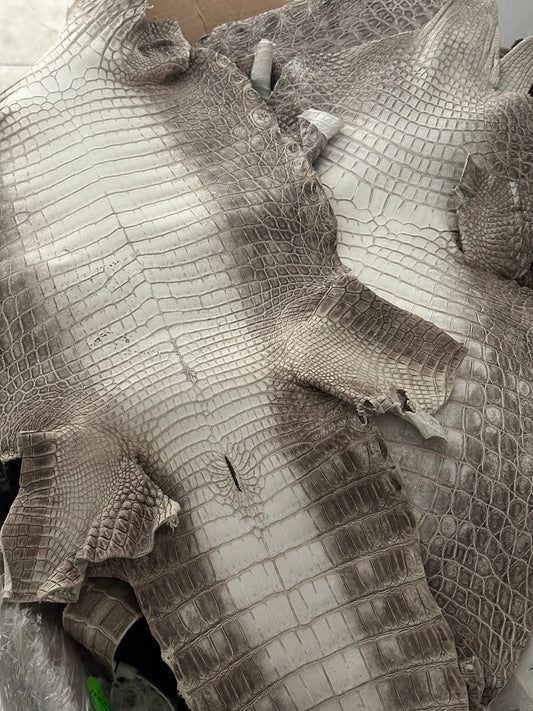

Himalayan Crocodile Leather: Why the World's Rarest Exotic Skin Is a Designer's Ultimate Investment
Share
There is a category of material that exists beyond trend cycles, beyond seasonal palettes, and beyond the reach of mass production. Himalayan crocodile leather occupies that category alone.
At Sunny Exotic Leather Tannery, we have spent years perfecting the sourcing, finishing, and delivery of this singular material. This post is not a sales pitch. It is a technical and philosophical case for why serious designers and artisans — those building work meant to last generations — choose Himalayan above all else.
What Is Himalayan Crocodile Leather?
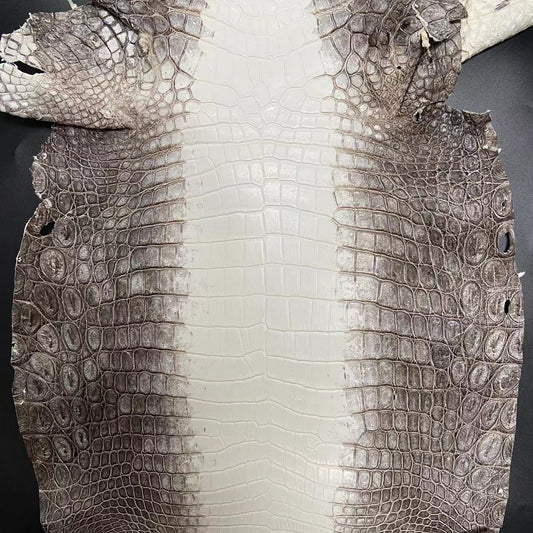
The term "Himalayan" does not refer to a species or a geography. It refers to a finishing process — a controlled, extended dyeing and tanning method that produces a stable, natural two-toned ombré across the belly of a crocodile skin.
The result is a gradual transition from a deep, rich base color at the flanks to a lighter, almost snow-capped tone at the center of the belly. When executed correctly — as it is at our tannery — the transition is seamless, balanced, and permanent. It does not fade. It does not crack. It does not peel.
This is not surface staining. This is not artificial contrast applied after the fact. The color lives inside the leather.
1. The Finishing Process: Why It Cannot Be Rushed
The Himalayan finish requires an extended, controlled dyeing cycle that most commercial tanneries will not invest in. The economics simply do not support it at scale.
At our tannery, each skin undergoes a multi-stage process:
- Initial preparation: The raw skin is cleaned, limed, and de-haired with precision to preserve scale integrity throughout.
- Drum dyeing: The skin is placed in a rotating drum with carefully calibrated dye concentrations. The ombré effect is achieved by controlling dye penetration depth — not by masking or overpainting.
- Matte finishing: A low-pressure, low-speed buffing process using natural waxes and oils produces the characteristic soft hand feel. The leather remains supple, flexible, and exceptionally durable.
- Quality verification: Every skin is inspected for symmetry, belly width, scale consistency, and color stability before it is approved for sale.
The result is a Grade I/II skin with 1.0–1.2mm average thickness, approximately 5 feet in length, and a belly width selected by the artisan — from 30cm to 35cm+.
2. Yield: The Metric That Separates Beautiful from Useful
A skin that photographs beautifully but yields poorly is a liability, not an asset. This is the conversation most suppliers avoid.
Our Himalayan skins are selected specifically for usable belly area. The belly — the flat, scale-symmetric center of the skin — is where your pattern pieces come from. A wide, clean belly means more usable material per skin, fewer joins in your finished piece, and a cleaner final aesthetic.
We select for:
- Balanced scale structure — symmetrical scales across the belly centerline, critical for panel-cut handbags and structured accessories.
- Consistent thickness — 1.0–1.2mm throughout, with no thin spots that would compromise lasting or edge finishing.
- Clean flank transitions — the ombré gradient begins at the flank, leaving the belly center available for your primary cuts.
When you order a Himalayan from our USA stock or Asia tannery, you are receiving a skin that has been technically verified — not just photographed.
3. Radical Honesty: Grade I vs. Grade II
We call a Grade-2 a Grade-2. This is not a common practice in the exotic leather industry, where grading standards are inconsistently applied and often inflated for marketing purposes.
Our grading system is straightforward:
- Grade I: Minimal natural imperfections, clean symmetry, full usable belly. Suitable for primary panel cuts on high-AOV pieces — seamless handbags, boot vamps, structured clutches.
- Grade II: Minor natural markings or slight asymmetry. Fully usable for smaller goods, accent panels, straps, and accessories. Priced accordingly.
You will never receive a Grade-II skin labeled as Grade-I from our tannery. The integrity of your production run depends on it — and so does ours.
4. CITES Documentation: Non-Negotiable in 2026
Every Himalayan crocodile skin we sell ships with full CITES documentation — the international certification that verifies legal, sustainable sourcing under the Convention on International Trade in Endangered Species.
In 2026, this is not optional. Whether you are a bespoke maker in the USA, a brand scaling into European retail, or a designer supplying luxury houses in Asia, your materials must be traceable and legally certified. Customs authorities, brand compliance teams, and increasingly, end consumers, are demanding it.
Our CITES protocols are finalized at the source — at the tannery level — before any skin leaves our supply chain. No shortcuts. No retroactive paperwork. Ironclad provenance from hide to bench.
5. Custom Colors: Exclusivity by Design
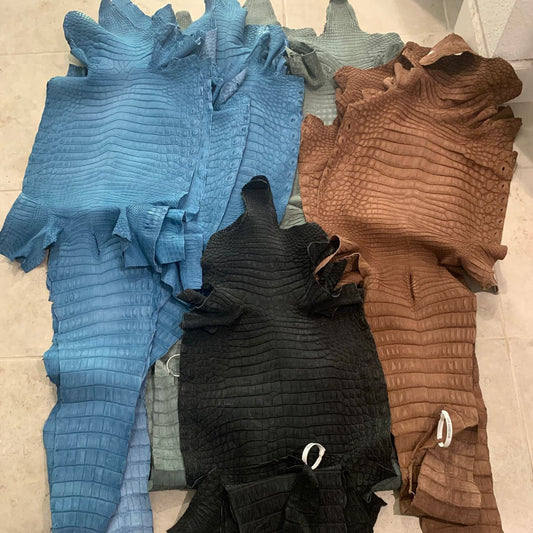
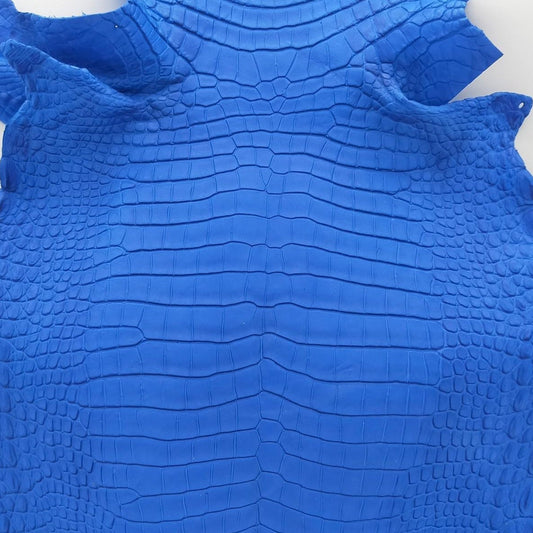
Beyond the classic Himalayan ombré, our tannery produces custom-colored Himalayan finishes — the same two-toned process applied over a curated palette of base colors including Blue, Green, Pink, Yellow, Red, and Purple.
Each color batch is limited. These are not mass-reproduced. The dye formulations are developed and controlled at our tannery, which means the color you receive is consistent within a batch — and genuinely exclusive across the broader market.
For designers building a signature aesthetic, this matters. Your Himalayan Blue is not the same as anyone else's Himalayan Blue. It is yours.
Who This Material Is For
Himalayan crocodile leather is a planning material, not an impulse purchase. It is for the designer who knows exactly what they are building before the skin arrives. It is for the artisan who understands that the material is half the craft.
It is for those creating:
- Seamless panel handbags and structured clutches
- Bespoke footwear — boot vamps, loafers, statement shoes
- Luxury watch straps and belts requiring consistent belly width
- Heirloom accessories built to outlast trends
If you are sourcing Himalayan for the first time, we recommend starting with a width that matches your primary pattern piece. Our team is available to advise on yield calculations before you order.
Secure Your Allocation
Himalayan crocodile skins are not a commodity. Global supply is finite, finishing capacity is limited, and demand from luxury houses continues to grow. Our exhibition-grade inventory — the same quality seen by global buyers at APLF 2026 — is available now, without corporate gatekeeping and without inflated MOQs.
Your search for a trusted, technical exotic leather source ends here.
God bless your masterpieces. 🙏


