






Why Does a $150,000 Himalayan Feel Like Plywood?
Share
Even the "Holy Grail" Peels. Here’s How to Fix It.
Primary Text: The tragedy of the secondhand market: Seeing a Himalayan Birkin in Shinjuku with leather peeling from the top handles near the stitching.
When handles peel, it’s rarely the artisan’s fault—it’s a failure of the fiber structure. If the leather is smoothed down too much or the grain is compromised during tanning, the edge-paint has nothing to "grip."
Our Tannery-Direct Grade 1 Selection focuses on high-density cross-linked fibers. This technical foundation ensures your edge-painting and handle-stitching stay intact for decades, not just seasons. Build a brand that outlasts the heritage houses.
Gemini said
This is a goldmine of a testimonial. It highlights exactly where the "Old Luxury" houses are failing the modern, high-conscientiousness buyer.
You can use this "Shinjuku Experience" to position Sunny Exotic Leather as the solution for designers who want to fix these technical flaws (the "plywood" stiffness, the peeling handles, and the processed interiors).
Here are four ad copies tailored to designers, using that specific "Okura" encounter as the hook.
Ad 1: The "Suppleness" Hook (Addressing the Plywood Texture)
Target: The Master Artisan/Lead Craftsman.
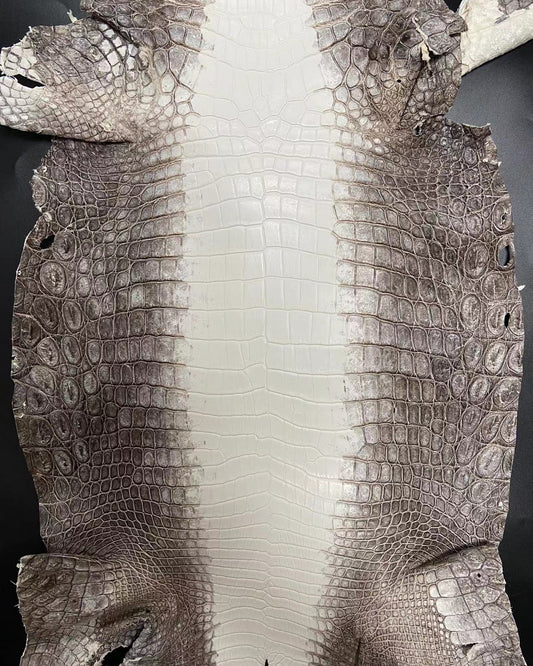
Headline: Why Does a $150,000 Himalayan Feel Like Plywood?
Primary Text: A designer recently visited Okura in Shinjuku and touched a legend. The verdict? "Firm like plywood or cardboard."
In the race for durability, many heritage houses over-process their exotic hides, sacrificing the organic soul of the leather for rigid structure. As an artisan, you know that true luxury shouldn't feel like a vintage suitcase—it should feel alive.
At Sunny Exotic Leather, our Grade 1 Himalayan Crocodylus niloticus is precision-tanned to 1.0mm−1.2mm to maintain structural integrity without the cardboard stiffness. We preserve the natural fiber density, allowing you to build bags that are light enough for the "loaf of bread" capacity but supple enough for a modern tactile experience.
CTA: [Don’t Settle for Stiff. Inspect Our Supple Grade 1.]
Ad 2: The "Handle Integrity" Hook (Addressing the Peeling)
Target: The Quality-Obsessed Maker.
Headline: Even the "Holy Grail" Peels. Here’s How to Fix It.
Primary Text: The tragedy of the secondhand market: Seeing a Himalayan Birkin in Shinjuku with leather peeling from the top handles near the stitching.
When handles peel, it’s rarely the artisan’s fault—it’s a failure of the fiber structure. If the leather is smoothed down too much or the grain is compromised during tanning, the edge-paint has nothing to "grip."
Our Tannery-Direct Grade 1 Selection focuses on high-density cross-linked fibers. This technical foundation ensures your edge-painting and handle-stitching stay intact for decades, not just seasons. Build a brand that outlasts the heritage houses.
CTA: [Secure Your Technical-Grade Allocation]
Ad 3: The "Full-Grain Interior" Hook (Addressing the Tactile Disappointment)
Target: The Designer who values the "Sensory Experience."
Headline: Don’t Let the Interior Kill the Dream.
Primary Text: "The inside felt like smoothed-over processed leather... I was really hoping I could feel more of a full grain."
That was the feedback from a designer visiting a famous Shinjuku atelier. When you use exotic materials, the client expects an exotic experience inside and out.
Why hide the natural beauty of the hide? Our tanning process in Perak, Malaysia, preserves the authentic pore structure and grain of the Crocodylus niloticus. We don't "process" the life out of our skins. We give you a foundation that feels as expensive as it looks.


