


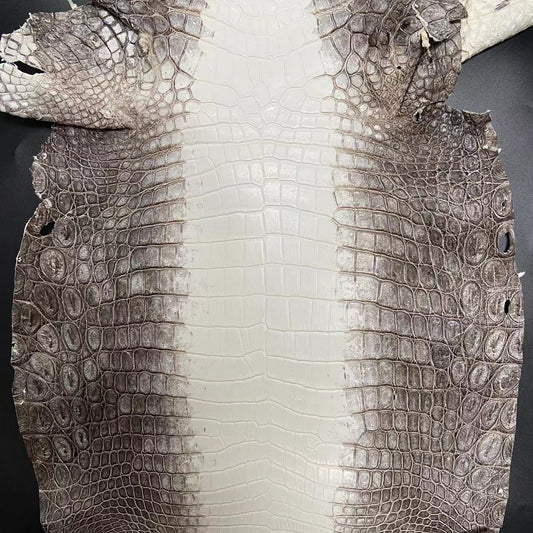

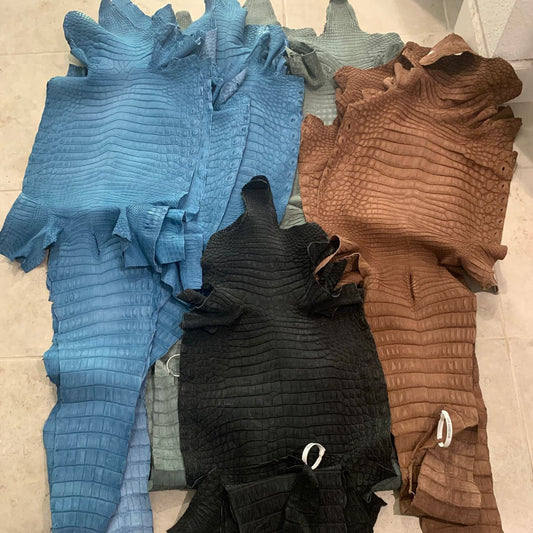


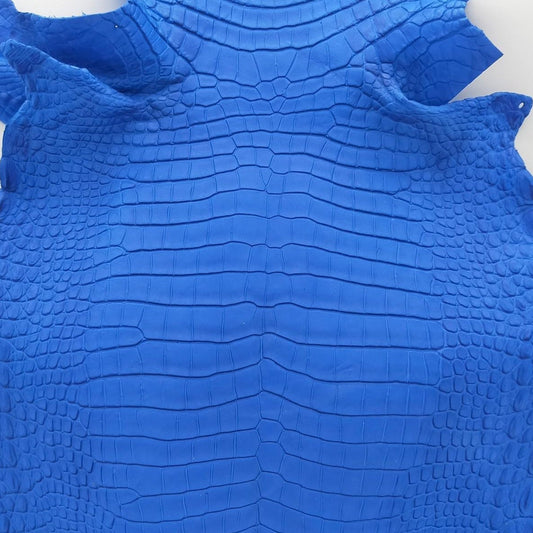

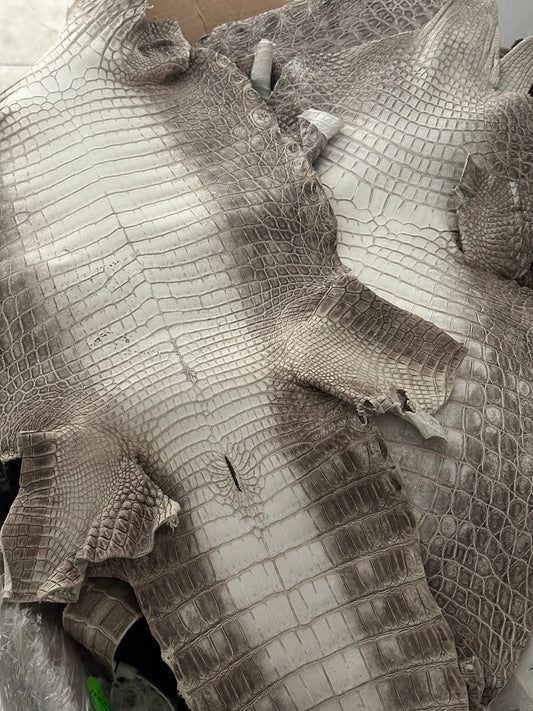

"95% Yield isn't a goal; it's a requirement. Here is how we define Grade 1 in our Perak facility."
Share
The Technical Protocol: A Master Artisan’s Guide to Sourcing High-Yield Exotic Leathers
In the world of bespoke craftsmanship, the most expensive mistake you can make isn't the price of the material—it is the opportunity cost of a failed foundation.
When a master artisan commits 40 to 60 hours of labor to a single commission, the structural integrity and aesthetic symmetry of the skin are the only variables that stand between a five-figure masterpiece and a high-waste liability. For the high-conscientiousness maker, sourcing is not about finding a "deal"; it is about mitigating yield risk.
To assist our partners in maintaining these standards, we have codified our internal grading discipline into this Technical Sourcing Protocol.
1. Surface Architecture & Grading Discipline
A "Grade 1" label is often used loosely by brokers, but for a professional atelier, it must have a mathematical definition.
-
Center-Cut Integrity: The primary 40cm+ belly panels must be free of umbilical scarring, grain pits, or calcification. Any defect in the center-line renders the skin "Commercial Grade," regardless of how clean the flanks are.
-
Scale Symmetry: In species like Crocodylus niloticus, symmetry is architectural. You should be able to draw a vertical axis down the center-line and see a near-mirror image in scale size and shape.
-
The Himalayan Stress Test: On a Himalayan finish, there is nowhere for trauma to hide. The "smoke-to-snow" gradient must be achieved through precision tanning, not pigment masking. If the white center feels "heavy" or "cakey," it is likely covering a surface defect.
2. The Physics of the Build
The beauty of a bag is seen, but its longevity is engineered. The tanning process must respect the biological limits of the hide.
-
Uniform Thickness: A professional-grade skin should maintain a consistent profile, typically $1.0\text{mm} - 1.2\text{mm}$. Inconsistency here leads to uneven skiving and structural weak points at the stitch line.
-
Fiber Density & $SPI$: High-quality tanning preserves the cross-linked collagen structure. This allows the artisan to achieve a higher Stitches Per Inch ($SPI$) without the leather "yawning" or tearing under the tension of the thread.
-
Edge Integrity: If a hide cannot accept a $0.3\text{mm}$ edge-skive while maintaining its tensile strength, it is unsuitable for high-end turned-edge construction.
3. Regulatory Security (CITES)
In 2026, global traceability is a non-negotiable component of luxury provenance.
-
Physical Traceability: Every skin must possess a tamper-proof, numbered CITES tag attached through the tail or flank.
-
Legal Export Protocols: A professional supplier handles the CITES export permit issuance as part of the service. Without a validated permit from the country of origin (such as our facility in Malaysia), the shipment is a total loss risk at customs.
-
Provenance Transparency: Sourcing direct from a tannery ensures a "closed-loop" supply chain, protecting your brand from the legal and ethical ambiguities of the broker market.
4. The Economics of Yield
A "cheaper" skin is often a mathematical trap.
Professional sourcing is a Margin Protection Game. If you purchase a "Grade B" skin for 30% less but lose 30% of the usable area to center-scars, you have effectively paid a premium for the privilege of more work.
Our Grade 1 Select skins are curated for a $95\%+$ usable yield. By maximizing the surface area of every hide, we allow the artisan to maximize their profit-per-hour—the only metric that truly matters in a bespoke studio.
The "Digital Handshake": Our Verification Guarantee
At Sunny Exotic Leather, we recognize that procurement is an act of trust. We do not expect our partners to source blindly based on stock photography.
For all high-value allocations, we offer a Live HD Video Inspection. This allow your lead craftsman to verify scale symmetry, pore structure, and gradient transitions before the CITES permits are finalized.
Stop gambling on your inventory. Start allocating with technical certainty.


