







The snow-capped peak of leathercraft.
Share
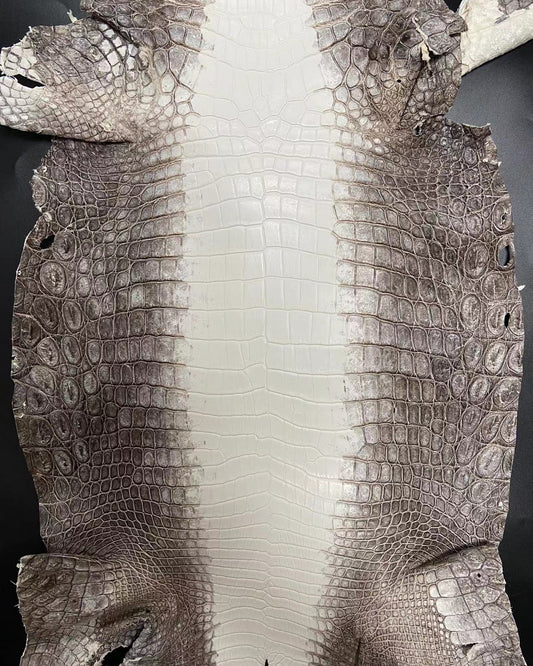
Himalayan crocodile leather is considered one of the rarest and most expensive luxury materials in the world. It is famous for its natural ombré shading that fades from snowy white to smoky gray, imitating the snow-capped Himalayan peaks. [1, 2, 3, 4, 5]
In the world of high-end leathercraft, one material stands entirely alone at the peak of exclusivity: Himalayan crocodile leather.
Renowned globally as one of the rarest and most expensive luxury materials in existence, it is instantly recognizable by its breathtaking ombré shading. The color transitions seamlessly from a snowy white center to smoky gray edges, beautifully mimicking the snow-capped peaks of the Himalayan mountains.
But what truly drives its legendary status? It comes down to three uncompromising factors:
- Flawless Sourcing: This leather is harvested exclusively from the Crocodylus niloticus (Nile crocodile). Elite artisans require perfectly symmetrical skins. Finding a hide entirely free of natural blemishes is an mathematical rarity.
- The Untampered Gradient: While standard tanning processes use heavy dyes to mask imperfections, the "Himalaya" finish cannot be faked. It demands a naturally pristine, white-centered hide. The beauty you see is entirely raw and unblemished.
- Intricate Craftsmanship: Lightening the center while preserving the natural dark flanks requires absolute precision. A single millimeter of error completely ruins the skin. Only the world’s most skilled artisans dare to touch it.
At Sunny Exotic Leather, we honor this dedication to perfection. For designers and creators who refuse to compromise, the Himalayan finish represents the absolute pinnacle of the craft.
Its legendary exclusivity stems from several factors:
- Strict Sourcing & Flawless Hides: The leather comes exclusively from the Crocodylus niloticus (Nile crocodile). Hermès and other elite tanners require flawlessly symmetrical skins without natural blemishes, which are incredibly difficult to source. [1, 2, 3, 4]
- The "Himalaya" Designation: To earn this title, hides must possess a natural, predominantly white center gradient. Dyeing the crocodile conceals imperfections, but the natural Himalaya finish cannot be artificially replicated, requiring pristine, unblemished leather to start. [1, 2, 3]
- Intricate Craftsmanship: Processing the delicate gradient requires absolute precision from highly skilled artisans, as any mistake ruins the skin. [1, 2, 3]


